
A planning resource for brand and sourcing teams. Engineering recommendations are not a statement of a particular project's specification, inspection standard, price, MOQ or delivery commitment.
Name the interface before designing it
Model-kit teams often use snap-fit as a broad label for several mechanisms. A tapered pin in a socket may rely mainly on interference and friction. A cantilever hook bends over a retaining feature. A keyed tab can locate a part without providing meaningful retention. These interfaces do not use the same equations, tooling or validation.
Define whether the connection is permanent, serviceable or repeatedly movable. Also state whether adhesive is prohibited, optional or expected. A one-time assembly connection can tolerate different behavior from a joint that must survive repeated posing.
Translate assembly intent into reviewable requirements
| Question | Why it matters | Evidence to review |
|---|---|---|
| How is the part inserted? | Misaligned or inaccessible assembly paths can overload a small feature before it engages. | Build sequence, hand access, keys and lead-in geometry. |
| What must hold after assembly? | Orientation, part mass and external loads change the retention need. | Defined use position and a project-specific retention check. |
| How often will it move? | One-time assembly and repeated articulation have different fatigue and wear risks. | Expected cycles, inspection points and end-of-test condition. |
| What variation is expected? | Mold, material and process variation can turn a nominal fit into looseness or excessive force. | Tolerance analysis followed by molded-trial measurements and builds. |
| What failure is unacceptable? | Breakage, stress whitening, visible gaps and accidental release require different controls. | Visible acceptance criteria and documented failure modes. |
Design the flexible feature and the mold together
For a cantilever-style snap, beam length, thickness, taper, root radius, hook geometry and allowed strain interact. Sharp roots can concentrate stress. The hook or undercut must also be released from the mold, which may require a pass-through, shutoff, lifter, slide or a different orientation. A mechanism that works in CAD but traps the steel is not production-ready.
Gate position and flow direction also matter because weld lines or residual stress can weaken a highly loaded root. These are engineering review points, not fixed dimensions that can be copied from another product.
Use the actual resin grade and production variation
Material-family names are only a starting point. Stiffness, allowable strain, shrinkage, impact behavior and molding conditions vary by grade, color and supplier. The mating parts may also shrink differently when their geometry, orientation or process changes. Select a grade against the interface requirement and the planned finishing process rather than assuming all ABS, HIPS or PVC behaves alike.
Tolerance analysis should cover the worst useful combinations, not only the center of a CAD model. Critical dimensions must be connected to a practical measurement method and to the assembly result they protect.
Prototype the experience, then validate molded parts
Early prototypes can expose a poor assembly path, collision or inaccessible feature. They cannot fully reproduce molded resin, gate influence, tool texture, process variation or long-term wear. Use them to learn, not to declare the interface production-approved.
On molded trials, build samples in the intended order and record insertion behavior, alignment, gaps, retention, release where applicable, whitening, damage and repeat-cycle observations defined by the project. If an interface is adjusted, repeat the relevant checks rather than approving it by visual inspection alone.
Snap-fit review checklist for an OEM brief
- Identify every press-fit, locating, retaining and moving interface separately.
- State the intended assembly order, adhesive policy and permitted user tools.
- Define whether each connection is one-time, removable or repeatedly articulated.
- Provide material preferences as hypotheses unless the resin grade is already approved.
- Mark visible gaps, stress whitening, breakage and accidental release criteria.
- Agree what prototypes can decide and what must wait for molded trial parts.
Related project evidence
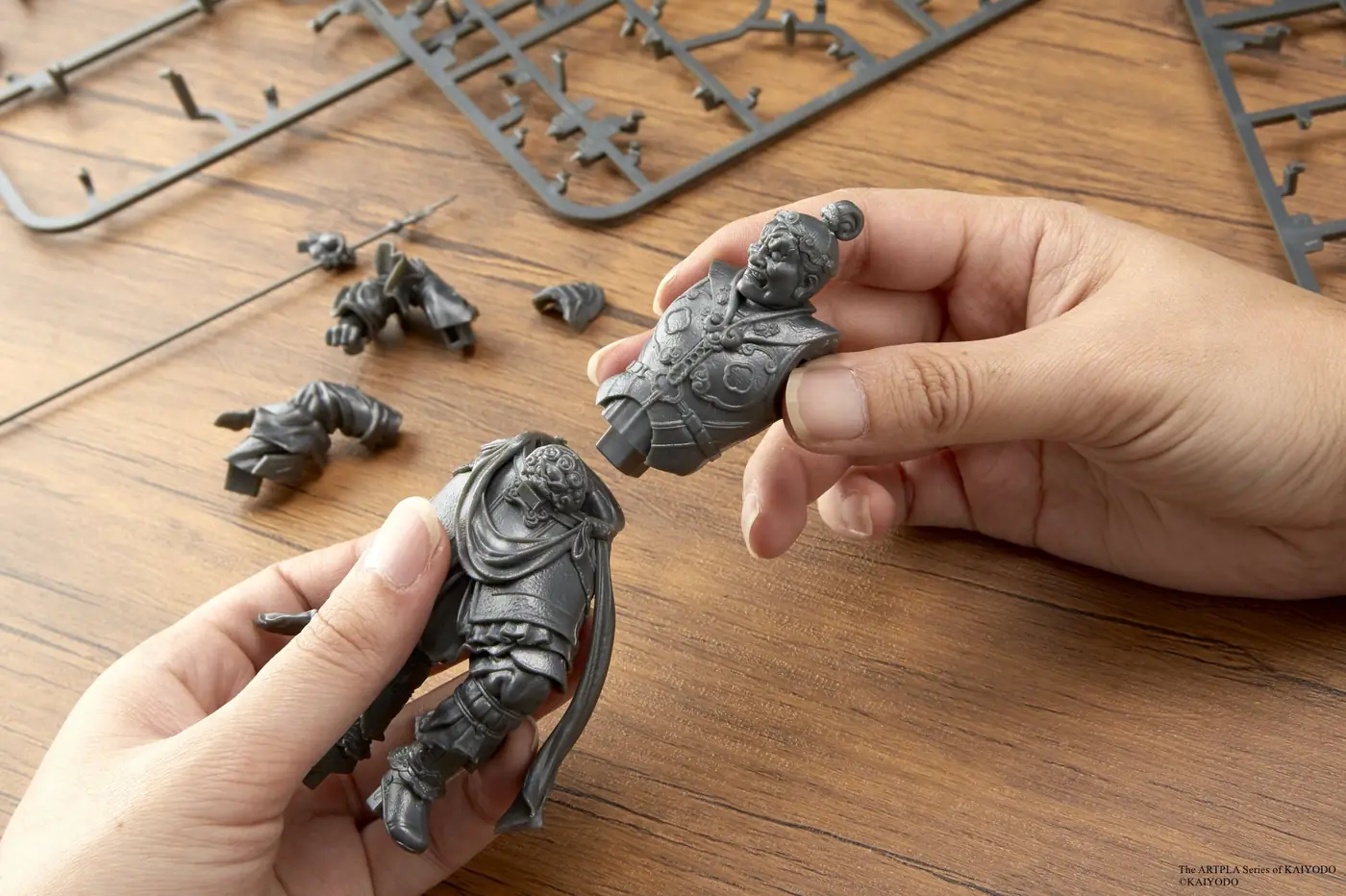
KAIYODO / ARTPLA names and images are shown with permission. The gallery illustrates the disclosed project; it is not a guarantee of specifications or test results for a new product.
Common buyer questions
Is a pin-and-socket joint the same as a snap-fit?
Not necessarily. A pin-and-socket joint may be a locating or interference fit, while a snap usually includes elastic deflection and mechanical retention. Name the mechanism so the correct material, tooling and test questions are used.
Can a 3D-printed prototype prove that a snap-fit will work?
It can reveal assembly-path and geometry issues, but its material and process differ from injection molding. Production approval should rely on the intended resin and representative molded parts under agreed checks.
Does ITTAK guarantee snap-fit or articulated construction?
No universal guarantee is published. The required interface, material, tool approach, user experience and validation plan must be reviewed for each project before capability or performance is confirmed.
References and further reading
- Covestro — Snap-Fit Joints for Plastics: A Design Guide
Material-manufacturer engineering background on snap geometry, strain, assembly and design calculation; not an ITTAK performance specification.
- Protolabs — Injection Molding Guide
Manufacturing guidance on clips, snap-fits, material choice and tooling consequences such as side actions.
- Syuto — Plastic Model Planning, Design and Manufacture
Primary manufacturer account of manual fit adjustment and test molding for model components; context, not an ITTAK promise.
Plan your next step
Start with a non-confidential overview. Ask about an NDA and an appropriate transfer method before sending unreleased designs.
Request a Project Review