
A planning resource for brand and sourcing teams. Engineering recommendations are not a statement of a particular project's specification, inspection standard, price, MOQ or delivery commitment.
Define what miniature means for this product
Miniature can describe a user-assembled scale kit, a diorama set, an architectural model, a gaming piece or a finished collectible. State which product is being sourced. For an injection-molded kit, define the scale, assembled use, whether painting or adhesive is expected, and whether the box contains one subject, a themed set or modular expansions.
A consistent scale is especially important when people, animals, vehicles and scenery are combined. Agree which real or fictional dimensions control the scale and how deliberate artistic exaggeration will be approved.
Six miniature-kit decisions to settle early
| Decision | Manufacturing question | Buyer outcome |
|---|---|---|
| Scale and silhouette | Which dimensions and recognizable features must survive reduction? | A consistent set that still reads correctly at viewing distance. |
| Fine detail | Can the feature be machined, filled, vented, released and inspected in the chosen material? | Detail based on production evidence rather than render magnification. |
| Part breakdown | Do undercuts or fragile projections require a split, action or redesign? | Manageable assembly without losing important form. |
| Runner and gate | Can small parts remain identifiable and be removed without damage? | Clear numbering, accessible cuts and controlled visible evidence. |
| Set composition | Which components are shared, repeated or unique across variants? | A controlled BOM for each set and future expansion. |
| Packaging | How are tiny, thin or decorated items retained and counted? | Reduced loss, mixing and transit damage at final pack-out. |
Balance visible detail with moldability
A feature visible in a close digital render may be too shallow to reproduce consistently or too delicate to release and handle. Review draft, depth, spacing, steel conditions, venting, fill path and surface finish at the intended physical scale. Decide whether a line should be molded relief, a decal, printing or omitted.
Long thin accessories, limbs, rails or poles may need special attention to flow, ejection and distortion. The correct response can be a different orientation, gate, part split or material review; no single minimum thickness or detail size applies to every geometry and tool.
Design the runner for human hands
Small parts need enough support to survive molding and packing but also a gate the builder can reach and trim. Numbering, runner letters and grouping should remain legible. Avoid placing several nearly identical parts without keys or instruction cues that distinguish them.
Review the intended tools and user skill. A collector kit that expects nippers and adhesive can use a different assembly route from a simplified promotional kit. If a loose component is safer than a runner-mounted one, define how it will be contained, counted and shown in the instructions.
Plan a series without confusing the first SKU
Modular scenery, shared figures and repeat accessories can support a broader collection, but only when revisions and ownership are controlled. Create a BOM and visual pack map for every SKU. Record which tools and parts are shared, which colors change, and how the correct combination reaches the correct box.
Do not overload the first tool with hypothetical future variants. Confirm that shared cavities, material, color and demand make sense together before they are treated as a saving.
Miniature kit manufacturing brief
- Authorized artwork or data, target scale and the real dimensions used to set it.
- Complete subject list, quantities per set, variants and planned shared components.
- Critical recognizable details and areas where engineering may simplify geometry.
- Assembly, adhesive, painting and expected user-tool requirements.
- Material and molded-color preferences, decoration, decals and surface priorities.
- Packaging contents, target markets, quantity range, schedule and approval owners.
Related project evidence
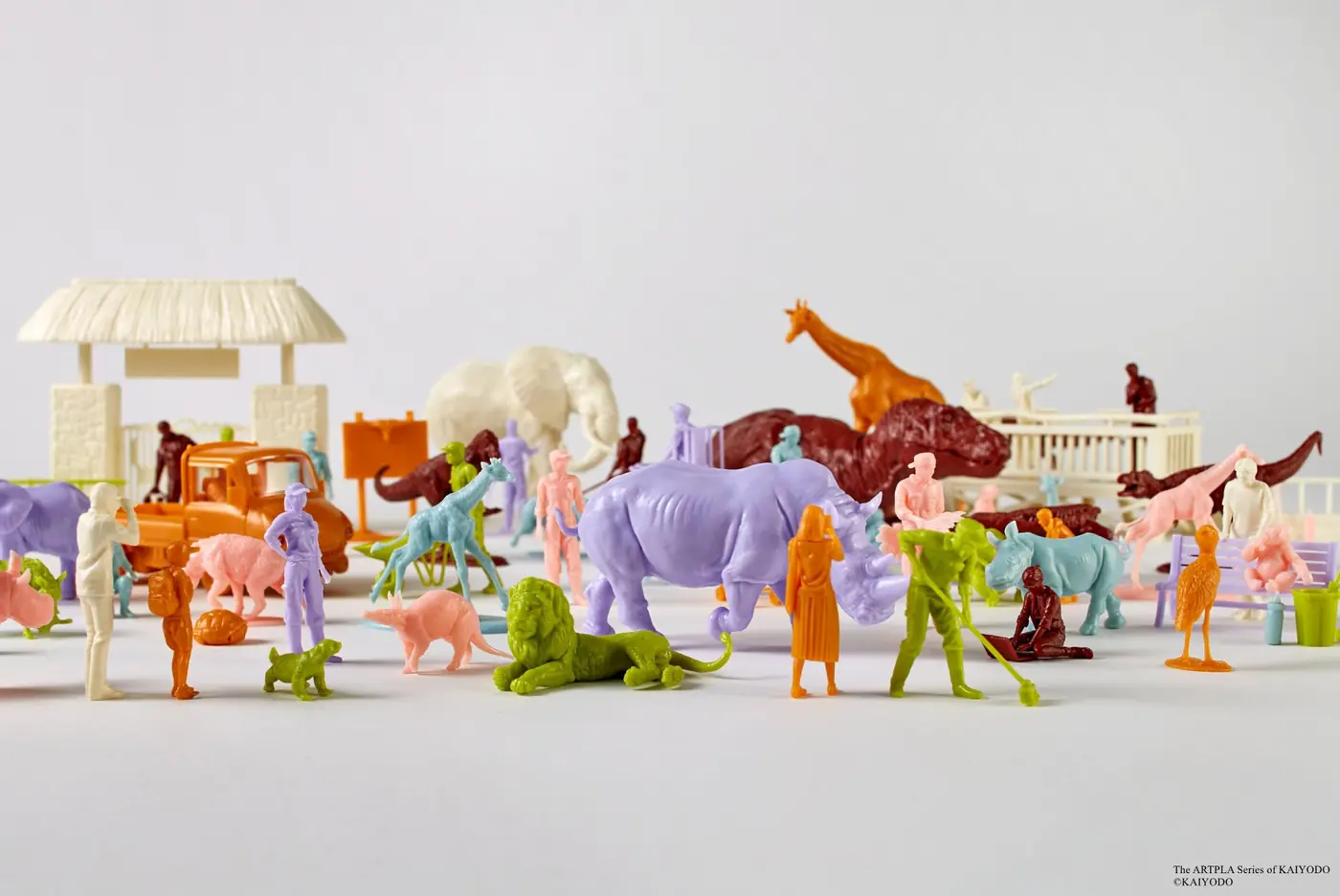
KAIYODO / ARTPLA names and images are shown with permission. The gallery illustrates the disclosed project; it is not a guarantee of specifications or test results for a new product.
Common buyer questions
What is the smallest detail an injection-molded miniature can reproduce?
There is no universal number. Geometry, depth, spacing, tool access, steel strength, resin, flow, venting, finish and inspection method all matter. Review the actual feature at final scale and confirm it with tooling and trial evidence.
Can several miniature subjects share one mold?
They may be able to share a mold when material, color, cavity balance, production quantity and tool layout support it. A family-mold decision should follow DFM rather than an assumption that small parts always belong together.
Can ITTAK manufacture a miniature series with multiple sets?
ITTAK's authorized Zoo Series gallery shows relevant multi-subject miniature project evidence. A new series still needs its own review of scale, parts, shared tools, variants, quantities, packaging and approval scope.
References and further reading
- KAIYODO — ARTPLA African Elephant and Visitors Set
Official 1/35 HIPS kit example specifying subjects, scenery, runner count and set contents; product context, not a universal design limit.
- Syuto — Plastic Model Planning, Design and Manufacture
Primary manufacturer examples covering scale railway kits, corporate models and model-kit planning from references through tooling.
- Protolabs — Injection Molding Guide
General manufacturing background on walls, draft, gates, ejection, material and common molding defects; not an ITTAK limit table.
Plan your next step
Start with a non-confidential overview. Ask about an NDA and an appropriate transfer method before sending unreleased designs.
Request a Project Review