
A planning resource for brand and sourcing teams. Engineering recommendations are not a statement of a particular project's specification, inspection standard, price, MOQ or delivery commitment.
Choose the architecture before counting parts
| Architecture | Questions to resolve | Manufacturing impact |
|---|---|---|
| Fixed-pose display kit | Final silhouette, support, seam strategy, adhesive or press-fit assembly and base stability. | Parts can prioritize sculpted form, but trapped geometry and build access still require DFM. |
| Limited-pose or selectable build | Which alternatives are chosen during assembly and which parts are shared? | Variant parts, keys, instructions and pack completeness become important. |
| Articulated model | Range, loads, retention, wear, repeated cycles, clearances and user handling. | Joint engineering, material grades, tolerance analysis and validation expand significantly. |
Build the brief around the intended customer experience
State the target scale or assembled dimensions, display pose, age grading, expected builder skill, adhesive policy and tools. Identify armor that must separate, optional equipment, effect parts, clear components, decals, color separation and the finished look expected without painting.
Provide rights-cleared artwork and mark what has already been approved by the IP owner. Orthographic references help, but distinctive proportions and dynamic poses may still require an explicit 3D review. Keep design approval separate from manufacturing approval so a visually accepted sculpt is not mistaken for tool-ready data.
Protect the silhouette while planning mold release
Mecha forms combine long panels, sharp transitions, layered armor, cylinders and dense surface detail. Decide which seam lines can follow panel boundaries and which surfaces must remain uninterrupted. Review long or thin parts for fill, ejection and distortion risk rather than simply preserving them as one piece.
Runner and gate decisions affect the builder as well as the mold. A gate on a sharp edge can be difficult to trim cleanly; a gate on a polished face can remain visible. Grouping must also consider material, molded color, part size and stable filling.
Treat joints and snap-fits as separate engineering work
If movement or glue-free retention is required, define each interface, expected load, assembly path and use cycle. Do not assume a joint from another kit can be scaled or copied. Resin grade, beam geometry, friction, shrinkage, surface condition and production variation all influence behavior.
Early prototypes can review collisions and range, while molded trials are needed for representative fit and material behavior. If the published project evidence is fixed-pose, the supplier must review articulated requirements rather than implying that the earlier case proves them.
Plan molded color, decoration and packaging as one system
A mecha can use molded color, paint, Tampo Print, decals or a mixture. Map each visible area to a process and define whether the buyer expects an acceptable unpainted build, a decorated part or a fully paint-ready surface. This mapping influences part splits, runners, masks, fixtures and approval samples.
Instructions should identify runners and variants clearly. Packaging must protect long panels, fine antennas, clear parts, decals and decorated surfaces while keeping every SKU complete.
What to send for a mecha manufacturing review
- Proof that the submitting party is authorized to develop the character or design.
- Concept art, orthographic views, available 3D data and target dimensions.
- Fixed-pose, selectable or articulated architecture and the intended assembly method.
- Required accessories, colorways, clear parts, decals, decoration and package contents.
- Estimated quantity range by SKU, target markets, schedule and approval owners.
- Unknown engineering items that the manufacturer is expected to propose or validate.
Related project evidence
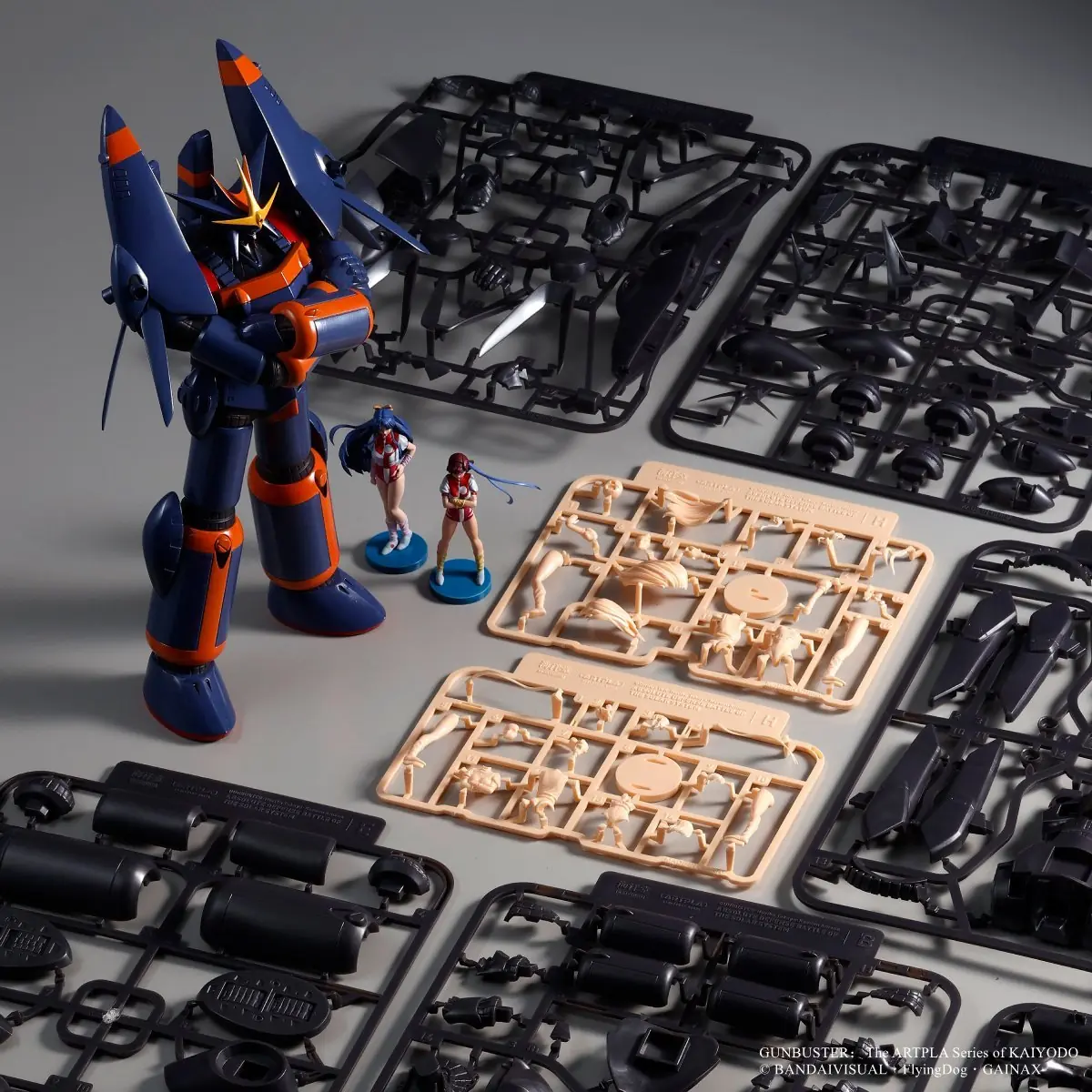
KAIYODO / ARTPLA names and images are shown with permission. The gallery illustrates the disclosed project; it is not a guarantee of specifications or test results for a new product.
Common buyer questions
Can ITTAK manufacture an articulated mecha model kit?
Articulation must be reviewed project by project. The public KAIYODO / ARTPLA galleries show relevant model-kit, mechanical-form, runner and tooling evidence, but they do not establish a universal articulated-joint or snap-fit capability claim.
Can a project start from concept art without completed CAD?
Yes, concept art can start a feasibility discussion. The team must still define product architecture, size, parts, materials, finishes and approvals before a reliable tool plan and production quote can be finalized.
Can several molded colors be included in one mecha kit?
Potentially, but each color and material group affects part splitting, runner organization, tools, production handling and pack-out. The final plan follows DFM and the approved product specification.
References and further reading
- KAIYODO — ARTPLA Evangelion Model-02 The Beast
Official brand example of a fixed-pose plastic model kit, useful for distinguishing pose architecture from articulated products.
- KAIYODO — ARTPLA Evangelion Three-Model Set
Official product evidence showing an HIPS kit, compact size, runner planning and an intentionally reduced part count.
- Kotobukiya — OEM Contract Manufacturing
Primary Japanese hobby-company background on OEM product definition, samples, specifications and production workflow; not evidence of ITTAK capability.
Plan your next step
- ARTPLA Gunbuster project gallery
- ARTPLA Evangelion Model-02 project gallery
- Plastic model kit manufacturing
Start with a non-confidential overview. Ask about an NDA and an appropriate transfer method before sending unreleased designs.
Request a Project Review